

What Causes a Car’s Black Box to Save Crash Data in a PA Accident?
Why Your Car’s Black Box May Become Key Evidence After a Serious Crash
Key Takeaways: A car’s event data recorder (EDR) keeps overwriting a short loop of driving data. It generally saves crash data when a sudden change in velocity meets or exceeds the trigger threshold, or when a non-reversible restraint such as an airbag deploys. Under 49 CFR 563.5, an event can be recorded even if the airbags don’t deploy, so a record from an earlier minor impact can sometimes be mixed up with the crash under investigation. In Pennsylvania homicide by vehicle cases, prosecutors often use EDR data on speed, braking, and throttle to try to prove a traffic violation and causation. That data has limits, though: sensors can be thrown off by skidding or damage, and the data must be retrieved correctly and handled under proper chain of custody. Because mandatory minimums and enhancements under 75 Pa.C.S. §§ 3732, 3735, and 3742 raise the stakes, it is critical to keep the vehicle intact and have the EDR evidence independently reviewed early.
A car’s black box, formally called an event data recorder (EDR), generally saves crash data when the vehicle’s sensors detect a sudden change in velocity that meets or exceeds the trigger threshold, or when an airbag or other non-reversible restraint deploys. Until then, the module keeps overwriting a short loop of driving data. For EDRs covered by federal rules, a qualifying event captures at least 5 seconds of pre-crash data. After a Pennsylvania fatal crash, prosecutors often treat this data as objective proof of speed, braking, and fault. But the data is not self-explanatory. It has to be retrieved, read, and put in context, and each step can be questioned.
If you or a loved one faces a felony vehicle charge, getting help early may help protect your rights and the evidence. Manchester and Associates offers free consultations and is available 24/7. Call (866) 996-7631 or contact us now to talk through your situation.
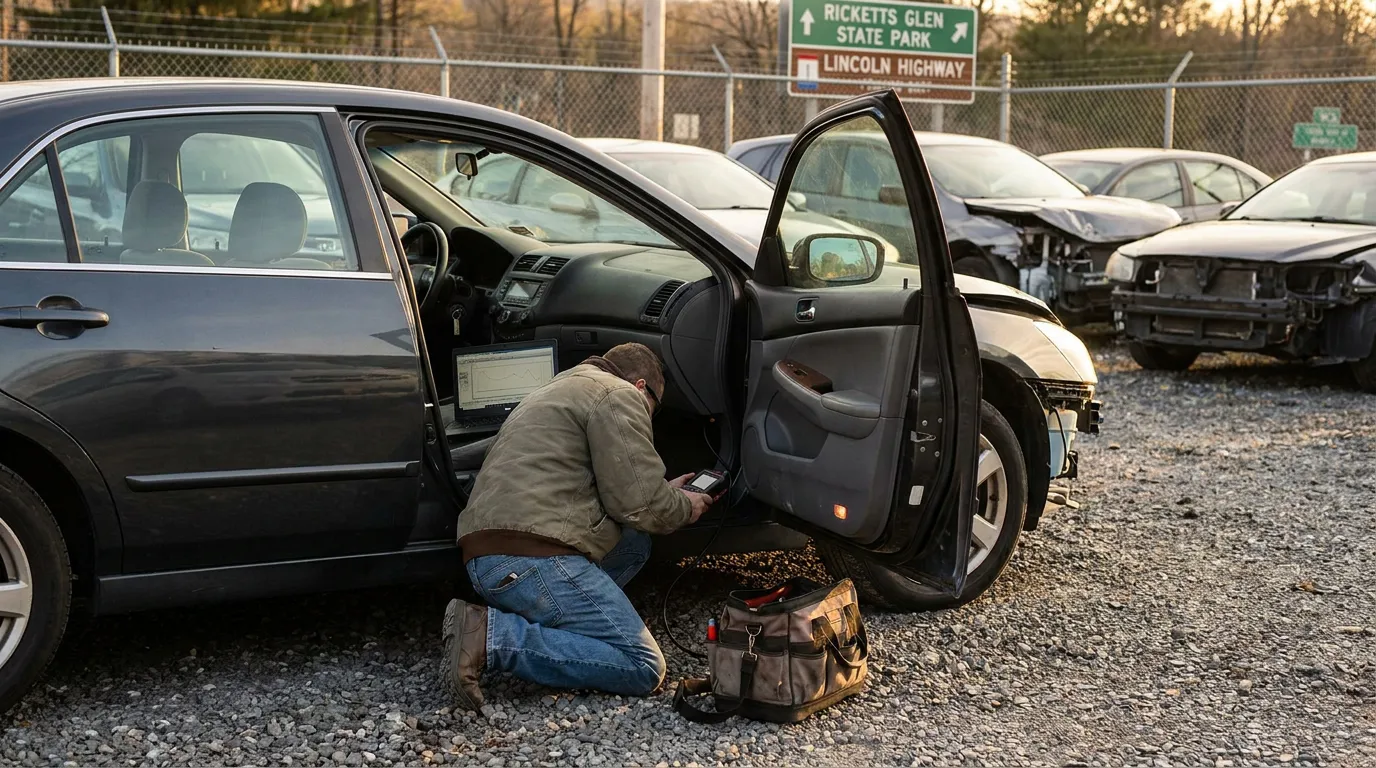
How an EDR Trigger Turns Routine Driving Data Into a Permanent Record
An EDR is usually built into the vehicle’s airbag control module and constantly tracks a short window of operating data. That data usually includes speed, braking, throttle position, and seatbelt use. Most of it is temporary and replaced as you drive. Data is generally saved only when the system detects a qualifying event, and even then it may not be permanent unless an airbag deployed.
The Federal Definition of a "Crash Event"
Federal regulations set out what counts as the trigger. Under 49 CFR 563.5 definitions, an "event" is a crash or other physical occurrence that meets or exceeds the trigger threshold, or that causes a non-reversible deployable restraint (such as an airbag) to deploy. The "trigger threshold" is a change in vehicle velocity (delta-V) of 8 km/h (about 5 mph) or more within a 150-millisecond interval. Part 563 does not require cars to have an EDR. It sets standards for EDRs in light vehicles made on or after September 1, 2012.
Deployment Event vs. Non-Deployment Event
A crash does not have to set off the airbags for the EDR to save data. Under 49 CFR 563.5, a non-deployment event meets the trigger threshold without deploying a non-reversible restraint. Under 49 CFR 563.9, deployment event data must be locked so it cannot be overwritten, while non-deployment data may be overwritten by later events. A non-deployment record from an earlier, minor bump could therefore be confused with data from the crash under investigation.
💡 Pro Tip: Ask whether the vehicle had any earlier impacts, such as a curb strike or minor collision. Multiple stored events can make it harder to know which record belongs to the crash at issue.
What Event Data Recorder Crash Evidence Typically Shows
EDR data usually covers a few seconds before and during impact, and investigators use it to reconstruct how a crash happened. Common data points include:
- Pre-crash vehicle speed
- Engine RPM and throttle position
- Brake application
- Steering input
- Seatbelt status
- Airbag deployment timing
These numbers can look precise, but they come from sensors with known limits. Wheel-speed sensors may report inaccurate speeds if the tires were skidding, spinning, or off the ground. Recording intervals may leave gaps, and not every vehicle records every data point. Reconstructionists on both sides may read the same data and reach different conclusions.
How Investigators Retrieve the Data
Getting data off an EDR generally requires dedicated hardware and software, such as the Bosch Crash Data Retrieval (CDR) system, along with trained technicians. Mistakes in connecting the tool, picking the right event, or reading the report can affect reliability. Defense counsel may examine who retrieved the data, how they did it, and whether the chain of custody stayed intact.
Why Black Box Recording Matters in Pennsylvania Homicide by Vehicle Cases
The Commonwealth often uses EDR data to try to prove two key elements: a traffic violation and causation. Under 75 Pa.C.S. § 3732(a), homicide by vehicle is a third-degree felony. It applies when a person recklessly or with gross negligence causes another person’s death while violating a state law or local ordinance on vehicle operation or traffic (other than DUI under 75 Pa.C.S. § 3802), and that violation caused the death. Data showing high pre-impact speed or no braking could bear on both.
EDR data alone, however, generally may not establish recklessness or gross negligence. A speed reading does not explain road conditions, visibility, another driver’s actions, or a mechanical failure. Those facts can be central to whether the Commonwealth can prove every element beyond a reasonable doubt.
DUI-Related Charges and Mandatory Minimums
When the Commonwealth alleges impairment, the stakes rise sharply. Under 75 Pa.C.S. § 3735(a)(1), unintentionally causing a death as the result of a DUI violation, with a conviction for that DUI, is a second-degree felony. It can become a first-degree felony with qualifying prior offenses or a concurrent conviction under 75 Pa.C.S. § 3802(h)(1). Under 75 Pa.C.S. § 3735(b), the Pennsylvania sentencing guidelines do not override the mandatory penalties in that section.
| Charge / Circumstance | Potential Consequence | Authority |
|---|---|---|
| Homicide by vehicle, DUI, first offense | 3-year mandatory minimum, plus consecutive 3 years per additional victim | 75 Pa.C.S. § 3735(a)(2) |
| DUI homicide, one prior offense | 5 years per victim | 75 Pa.C.S. § 3735(a)(3) |
| DUI homicide, two or more priors or prior § 3802(h)(1) conviction | 7 years per victim | 75 Pa.C.S. § 3735(a)(3)(ii) |
| Homicide by vehicle in active work zone or with listed companion offenses | Up to 5 additional years of confinement | 75 Pa.C.S. § 3732(b)(1), (b)(1.1) |
| Leaving the scene, death | Second-degree felony; 3-year minimum and $2,500 minimum fine | 75 Pa.C.S. § 3742(b)(3) |
| Leaving the scene, serious bodily injury | Third-degree felony; 90-day minimum and $1,000 fine | 75 Pa.C.S. § 3742(b)(2) |
Enhancements carry procedural requirements of their own. Under 75 Pa.C.S. § 3732(b)(2), the Commonwealth must give the defendant notice that it intends to seek the enhanced sentence. Because enhancements raise the possible penalty, the facts behind them generally must be proven beyond a reasonable doubt. You can review the full text of Pennsylvania’s Vehicle Code for these provisions.
Leaving the Scene and the Role of Crash Data Storage
Pennsylvania law requires a driver involved in a crash that injures or kills anyone to stop immediately at the scene, or as close to it as possible. Under 75 Pa.C.S. § 3742(a), the driver must stay until meeting the duties under 75 Pa.C.S. § 3744 to give information and render aid. Under 75 Pa.C.S. § 3742(c), courts cannot impose a lesser sentence, probation, or a suspended sentence for the felony grades of this offense. Courts generally require proof that the driver knew, or reasonably should have known, of a crash involving injury. EDR timing data could help confirm or dispute when and how a collision happened.
Challenging PA Accident Evidence From the Black Box
The defense does not have to accept the Commonwealth’s reading of EDR data as final. An independent review may turn up issues such as:
- Whether the recorded event actually matches the crash under investigation
- Whether sensor readings were distorted by skidding, tire slip, or vehicle damage
- Whether the download followed proper procedures and kept the chain of custody intact
- Whether the vehicle was searched and the data obtained lawfully
Constitutional protections may also apply to how police got the data. Questions about search warrants and consent could affect whether the evidence is admissible, and courts weigh them case by case. An experienced PA accident evidence lawyer can review whether the evidence was handled correctly.
💡 Pro Tip: Do not let anyone access, repair, or scrap your vehicle without legal guidance. The car itself may hold evidence that supports your defense.
Acting early matters because vehicles are often repaired, salvaged, or released soon after a crash. Once a vehicle is gone, the defense may lose the chance to examine the module on its own. You can find more guidance in our criminal defense legal blog.
Frequently Asked Questions
1. Does every crash cause the black box to save data?
No, not in every case. The EDR generally saves data only when the change in velocity meets the trigger threshold or a non-reversible restraint such as an airbag deploys.
2. Can EDR data be saved if the airbags did not deploy?
Yes. Under 49 CFR 563.5, a non-deployment event still meets the trigger threshold, so data may be saved. Unlike deployment data, though, those records may be overwritten by later events.
3. Is event data recorder crash evidence always accurate?
EDR data is generally considered reliable, but it has limits. Sensor errors, wheel slip, and mistakes during retrieval can affect accuracy. Independent analysis can help test the Commonwealth’s conclusions.
4. Can police download my car’s black box without permission?
It depends on the circumstances. Whether a warrant or consent was needed can turn on the specific facts and how the data was obtained.
5. Does EDR data prove I was reckless?
Generally not by itself. Under 75 Pa.C.S. § 3732(a), the Commonwealth must prove recklessness or gross negligence, a traffic violation, and that the violation caused the death.
Protecting Your Defense When Crash Data Is on the Line
A car’s black box generally saves crash data when a sharp change in velocity or airbag deployment triggers the recording. That data can carry real weight in a Pennsylvania homicide by vehicle case, but it still has to be retrieved correctly, matched to the right event, and read in context. Mandatory minimums and enhancements under 75 Pa.C.S. §§ 3732, 3735, and 3742 make it critical to test this evidence carefully and early.
You do not have to face the Commonwealth’s evidence alone. Manchester and Associates is available 24/7 and offers free consultations to people facing serious felony vehicle charges in Pennsylvania. Call (866) 996-7631 or schedule your free consultation today.
Disclaimer: This content is for informational purposes only and is not legal advice. Every case is unique, and results may vary. Consult an attorney about your specific circumstances.